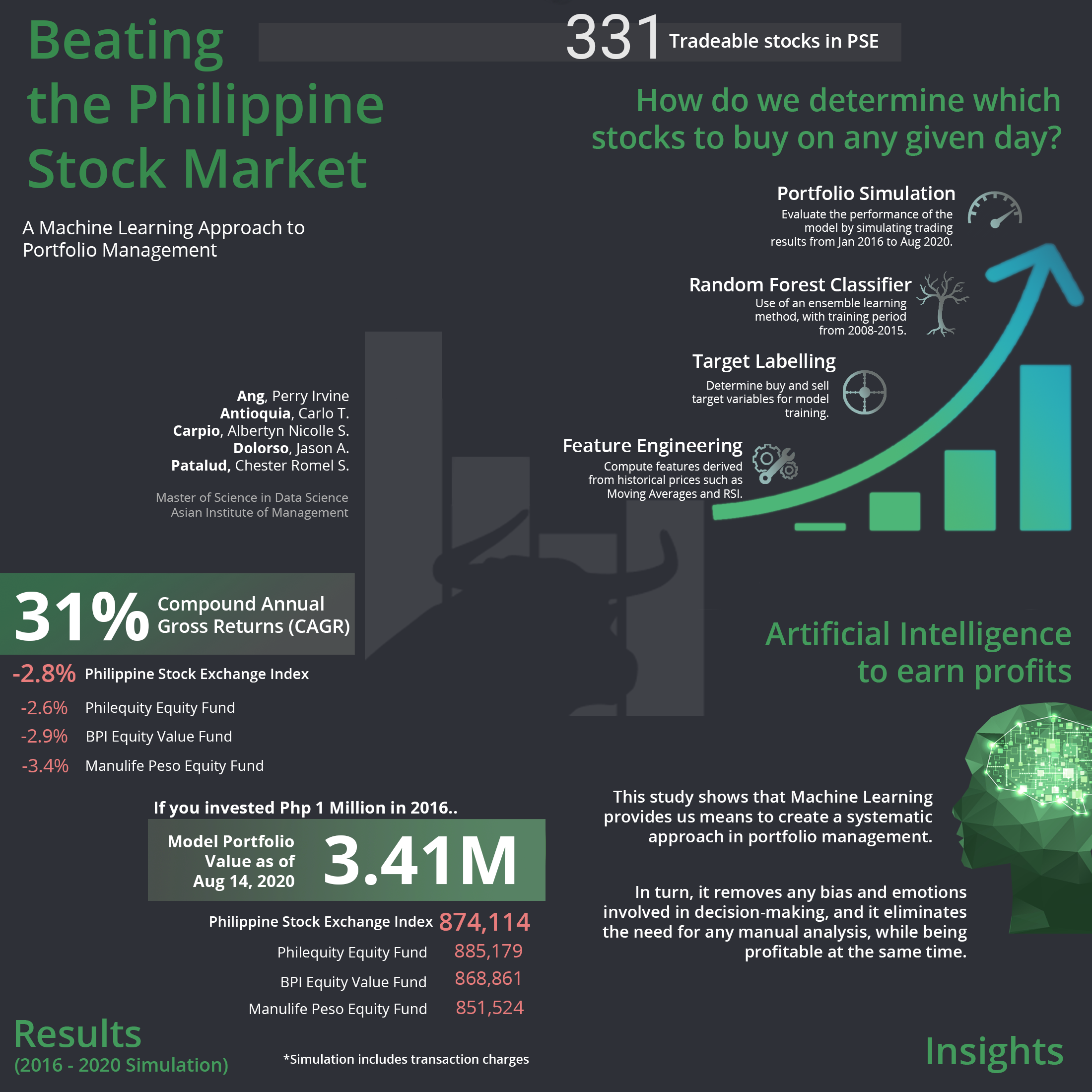
Beating the Philippine Stock Market: A Machine Learning Approach to Portfolio Management
Asian Institute of Management
Abstract
The stock market is one of the ways a person can earn passive income, and there have been many attempts to look for the holy grail: a trading strategy that can consistently yield profits for the investor. In this paper, we address the core problem of most stock investors — classifying which stocks to buy on any given day. Features used were mostly based on price, trading volume, or volatility, across multiple timeframes.
The algorithm used was a Random Forest Classifier, trained on 2008-2015 Philippine Stock Exchange (PSE) stocks. For model evaluation, a portfolio was simulated from 2016 to 2020, with an analysis of its expected returns based on stocks picked by the model.
The results show that our model portfolio achieved +240.70% in total return — a PHP 1 million initial capital growing to PHP 3.4 million in less than 5 years — compared to the PSEi, which incurred a 12.29% loss over the same period. On an annualized basis, the model portfolio achieved a 31% compound annual growth rate (CAGR), outperforming existing equity funds ranging from -2.6% to -4.0%. These results show that through machine learning, we were able to develop a systematic approach to portfolio management.
Keywords: stock market; stock trading; investment; portfolio management; algorithmic trading
Availability of source codes for this project will be limited to the project team until further notice.