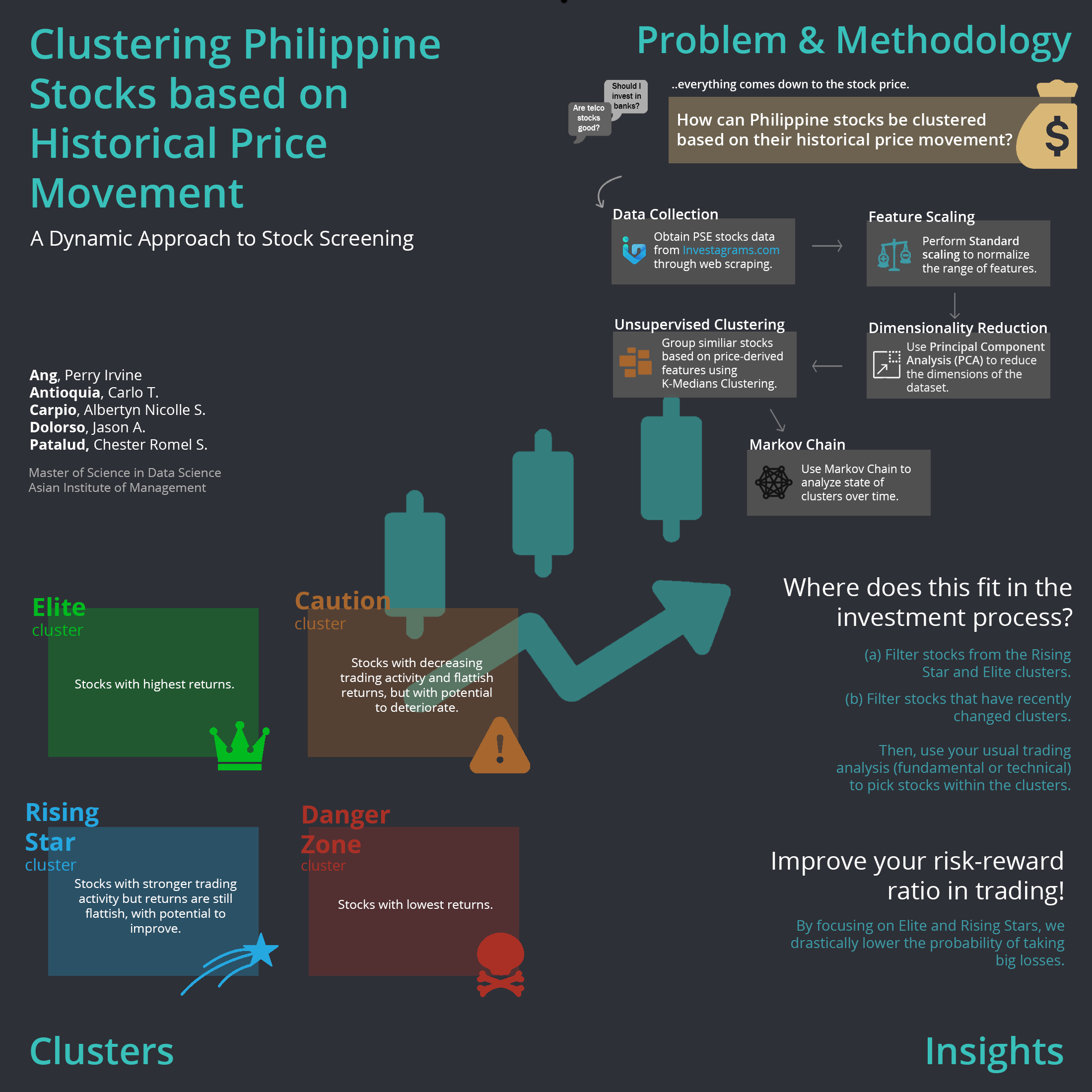
Clustering Philippine Stocks based on Historical Price Movement: A Dynamic Approach to Stock Screening
Asian Institute of Management
Executive Summary
The stock market is one of the most common ways to earn passive income, but the inevitable question is: which stocks should we invest in? Discussions on this usually analyze stocks by industry or company size, often leading to varying opinions. Regardless of the framing, all these discussions seek to answer one thing: whether a stock will go up or down. So rather than the traditional industry- or size-based grouping, we explored clustering stocks solely on their historical price movement.
We obtained historical daily trading data for all Philippine stocks from 2008 to August 2020, combining web-scraped data with historical data shared by BOH Society and Stock Market Pilipinas. We identified 4 clusters:
- Elite — highest returns, rising volume.
- Rising Stars — highest average value turnover, most volatile, relatively higher net foreign flow.
- Caution — declining volume, least volatile.
- Danger Zone — lowest returns, lowest net foreign flow.
Using Markov Chain analysis, we found that stocks in the Rising Stars cluster have the highest probability of entering the Elite cluster, and that both Elite and Rising Stars have the lowest probabilities of falling into the Danger Zone. The main insight: focus on stocks in the Elite and Rising Stars clusters, which simplifies stock filtering and improves risk-reward by avoiding the Danger Zone.
Availability of source codes for this project will be limited to the project team until further notice.